Updated on:
November 9, 2026
Budget 2026 and the Industrial Test of Canadian Sovereignty
by

Samuel Associates
Posted on:
November 9, 2026
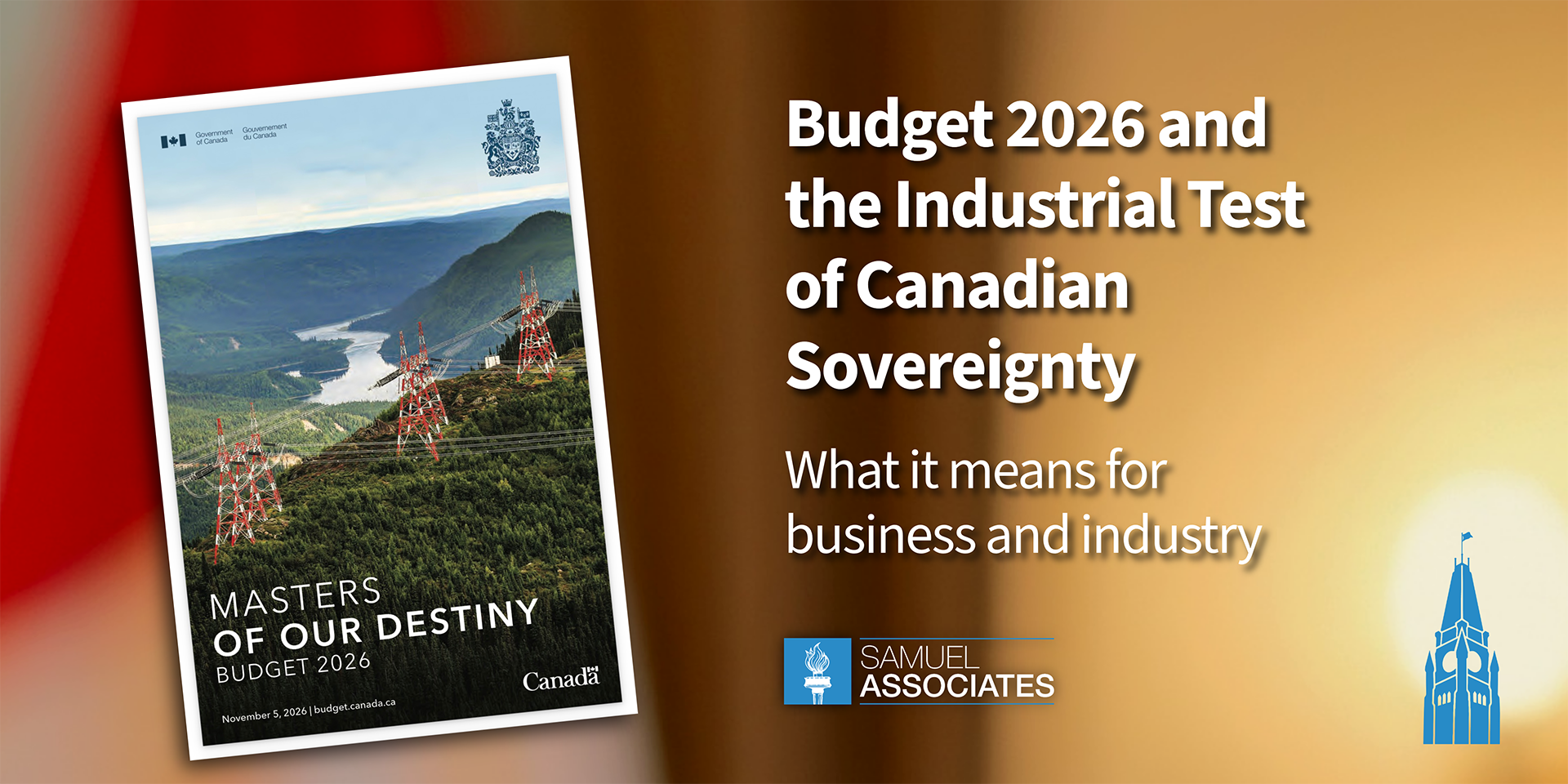
To see full published article, click here.
To see full published article, click here.

Media Contact
Katie Majkowicz
Digital Marketing & Communications Specialist
Samuel Associates Inc.
Digital Marketing & Communications Specialist
Samuel Associates Inc.
(613) 292-3936
km@samuel.associates
Related Article
No items found.
No items found.
No items found.

Ottawa is tying military readiness to the capacity to build and sustain it at home. For defence and national security suppliers, the opportunity depends on turning that ambition into capabilities Canada can use.
An Arctic surveillance aircraft depends on more than its radar. It needs secure communications, trained technicians, spare parts and somewhere to land. A shortage in any of those supporting systems can determine whether an expensive platform is available when Canada needs it.
That relationship between equipment and the capacity to keep it working runs through the 2026 federal budget. Ottawa is treating defence spending as a means of strengthening Canadian industry, alongside its military purpose. For companies seeking defence and national security business, the resulting opportunity reaches well beyond the purchase of major weapons systems.
Our assessment at Samuel Associates is that the strongest commercial prospects will belong to firms that can connect a specific operational need with a credible plan to deliver and support it. Understanding where the money sits, who controls the requirement and what Canada expects to retain at home will matter as much as the technology itself.
What the spending figures actually show
The budget describes more than $700 billion in defence and security investment over five years, beginning in 2026–27. That figure combines core defence expenditure with broader spending on security and resilience. It includes existing commitments and expenditures such as personnel and operations. It cannot be read as $700 billion in newly available procurement contracts.
Table 5.1 provides the more useful starting point for understanding the military spending trajectory. Core defence spending is projected at $75.1 billion in 2026–27, rising to $99.2 billion in 2030–31, on a cash basis. The five-year total is approximately $451.3 billion. These figures describe payments, the basis used for NATO reporting; they differ from the accrual expenses recorded in the federal budget.
There is a consequential distinction in the GDP percentages, too. The budget projects combined core and broader security spending of roughly 4.1 percent of GDP from 2027–28. Core defence spending alone reaches 2.6 percent in that year and remains at that level through 2030–31 in the published table. NATO’s 2035 commitment separates 3.5 percent for core defence from 1.5 percent for broader defence and security investment. Further commitments would therefore be needed to close the remaining core defence gap; the budget notes that its projections exclude future government commitments.
The proposed $7.6 billion over five years for extending and expanding Operation REASSURANCE makes the distinction between new and existing money tangible. Beginning in 2026–27, this cash funding would come from existing National Defence resources. Its commercial relevance lies in the sustained deployment it supports, which suggests continuing requirements for logistics, maintenance and other operational support in Europe.
For suppliers, the practical task is to follow a budget announcement through to a funded requirement and an identifiable purchasing process. Some measures redirect existing resources. Others begin in a later fiscal year. A larger spending envelope improves the outlook, but its timing and composition determine when a company can realistically earn revenue.
The supply chain becomes part of defence policy
The budget proposes directing up to $2.7 billion over five years, starting in 2026–27, toward defence industrial priorities. This is cash funding drawn from previously announced resources. Its significance lies in where Ottawa intends to put it.
Among the priorities are nitrocellulose production for munitions and high-grade ballistic steel for armoured vehicles. Alongside them are quantum computing, a sovereign medium-lift space launch capability and secure facilities where industry can work with National Defence. These investments address different technologies, but share a concern with the dependencies that can limit Canada’s freedom to act.
The industrial implications extend to specialist manufacturers and companies that have never supplied a complete military platform. Production machinery, materials processing and testing services may become valuable parts of a larger defence supply chain. The commercial case will depend on a firm showing how its contribution removes a specific production constraint or makes supply more dependable.
Ottawa also identifies support through BOREALIS, Defence Industry Assist and the Regional Defence Investment Initiative. Companies should assess these as possible routes to developing capacity and entering supply chains. Program support and procurement serve different purposes, and a successful funding application does not establish a future customer.
Drones offer a concrete test of faster purchasing
The Defence Drone Initiative is one of the budget’s clearest signals of demand. It proposes $2.3 billion over five years, beginning in 2027–28, on a cash basis, to accelerate the acquisition and deployment of uncrewed and counter-uncrewed capabilities. Part of that funding is already provisioned in the fiscal framework.
The budget reports that the initiative’s first contract was awarded in 50 days. One award cannot establish how quickly the wider system will operate, but it gives industry a concrete example against which to judge the promise of faster procurement. The initiative’s marketplace is intended to help promising Canadian technologies reach operational testing and, where they meet defence requirements, production.
Our reading is that opportunities could extend across platforms, sensors, communications and counter-drone systems, with integration and sustainment determining their operational value. Suppliers should be prepared to demonstrate how equipment performs in the intended environment and works with systems already in service. A convincing trial should also establish what training, maintenance and production capacity a larger order would require.
Canadian partnerships need an industrial purpose
The Defence Investment Agency sits at the centre of the government’s effort to connect procurement with its Defence Industrial Strategy and Build-Partner-Buy framework. The budget describes legislation introduced in October to establish the agency as a Crown corporation. That proposed statutory structure should be distinguished from the agency’s procurement work already underway.
For Canadian businesses, the policy direction creates a stronger case for investing in domestic capability. For international firms, it raises the importance of a substantive Canadian industrial role. Our assessment is that proposals will be more persuasive when they explain where engineering and maintenance will occur, how Canadian partners will participate and what access Canada will have to the technical information required to support equipment.
The budget itself illustrates why companies must examine the stage of each project. It records a preferred supplier for the submarine program and a non-binding term sheet for a potential GlobalEye aircraft acquisition. Those represent different levels of commercial maturity. For a new entrant, the realistic opening may lie in a prime contractor’s supply chain or a future sustainment requirement.
Building domestic capacity also takes time, while some military requirements are urgent. A credible proposal should explain how initial delivery and the development of Canadian production or support would fit together. Companies should use the relevant market consultations and supplier processes to test that plan, with a clear understanding of the end user and contracting authority.
National security demand extends beyond the military
One of the budget’s most substantial national security proposals is $6 billion over ten years, starting in 2027–28, on a cash basis, for the Canadian Security Intelligence Service, with $579.5 million in ongoing funding. Its stated purposes include expanding the service’s capabilities and presence and reducing reliance on foreign partners.
The budget does not identify how much of that total would become private-sector procurement. Nevertheless, expanding sovereign intelligence capacity suggests potential demand for secure information systems and the infrastructure needed to handle sensitive data. Technology companies should assess those needs while recognising that personnel and operations will also draw on the funding.
In the North, the budget connects military readiness with transport infrastructure and sustained access. It highlights the Mackenzie Valley Highway and Grays Bay Road and Port, alongside northern operational infrastructure. This points to potential work in construction, remote support and communications. Companies pursuing it will need delivery plans shaped by northern conditions and meaningful relationships with Indigenous and local partners.
At the border, the budget proposes $192.5 million over four years, starting in 2027–28, and $42.5 million in ongoing funding for the Canada Border Services Agency to modernise and stabilise critical border technology infrastructure. Suppliers of reliable digital infrastructure should investigate the resulting requirements, including the security and integration work needed to keep border systems operating.
Financing growth and reaching allied markets
A small manufacturer can identify a promising contract and still struggle to finance the equipment or inventory needed to deliver it. The budget highlights the Business Development Bank of Canada’s existing $6 billion Defence Platform as a source of financing, investment and advice. It also proposes a transition toward a single federal development bank combining BDC and Export Development Canada, while maintaining existing products during the transition.
The planned Defence, Security and Resilience Bank could add another source of long-term financing. The budget anticipates signing its founding agreement on November 30, 2026, with full operationalisation in 2027. Suppliers should follow its development while building their immediate plans around financing they can actually secure.
Allied markets are part of the same industrial argument. The budget records Canada’s participation in the European Union’s €150 billion Security Action for Europe facility, which improves access to joint defence procurement. Separately, Canada’s intended participation in the EU’s Ukraine Support Loan could allow Canadian companies to compete for approximately €60 billion in Ukrainian defence procurement. That prospective access remains dependent on the participation arrangements and applicable procurement conditions.
For a Canadian supplier, an allied partnership can help support production volumes beyond the domestic market. For an international company, investment in Canada may strengthen its role across allied supply chains. Both cases require careful examination of eligibility and the ability to support customers over time.
The next decision for suppliers
Companies should begin with a defined operational problem and identify the program or customer responsible for solving it. They can then test the maturity of the requirement, decide whether to pursue a direct contract or a place in a prime contractor’s supply chain, and match their investment timetable to the likely purchasing schedule.
The proposal must explain how delivery will work. That means addressing applicable security and export requirements early, substantiating production capacity and costing support over the equipment’s useful life. The budget’s wider review of federal contracting emphasises clearer requirements, stronger performance expectations and better pricing. Growing defence expenditure will coexist with pressure to demonstrate value.
Budget 2026 gives companies a clearer view of the capabilities Ottawa wants Canada to possess. Its success will become visible in dependable production and equipment that can remain in service. For the surveillance aircraft in the Arctic, that ultimately means having the communications, technicians and replacement parts available when the mission requires them. Suppliers able to make that possible have a compelling reason to engage now.
To see full published article, click here.

To see full published article, click here.