Updated on:
November 10, 2026
Building the Infrastructure for Canadian Defence Readiness
by

Samuel Associates
Posted on:
November 10, 2026
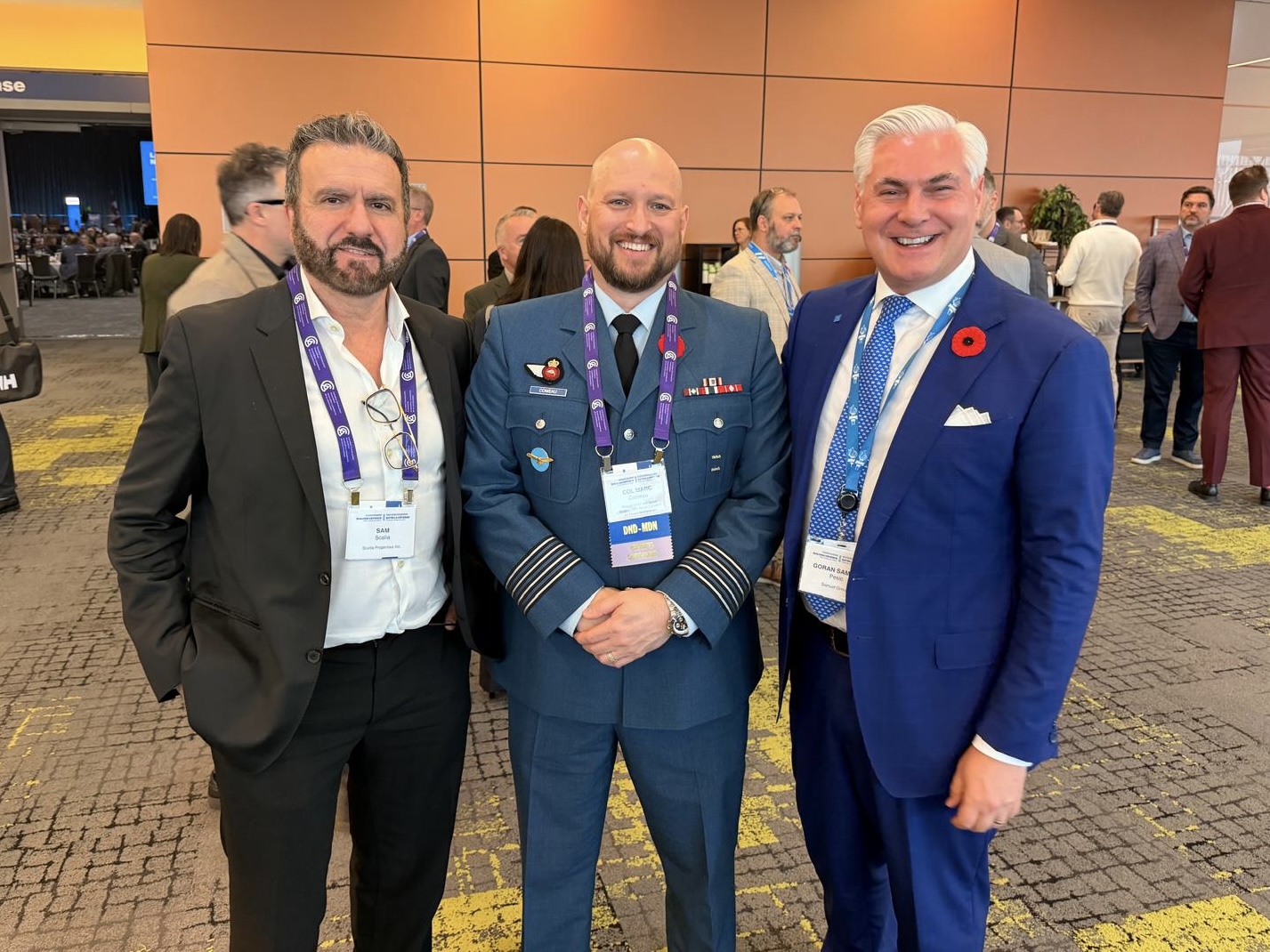
Sam Scalia, Founder and CEO of Scalia Properties, Montréal; Colonel Marc Comeau, Director, Air & Space Support, RCAF, Department of National Defence; and Goran Samuel Pesic, President and CEO of the Samuel Group of Companies, at the 2026 DND/DCC Industry Days “Building Defence” conference in Ottawa.
To see full published article, click here.
To see full published article, click here.

Media Contact
Katie Majkowicz
Digital Marketing & Communications Specialist
Samuel Associates Inc.
Digital Marketing & Communications Specialist
Samuel Associates Inc.
(613) 292-3936
km@samuel.associates
Related Article
No items found.
No items found.
No items found.

Canada’s ability to strengthen its defence depends on the infrastructure that makes military capability usable. Aircraft need suitable runways and secure hangars. Ships require berthing and maintenance facilities. A growing force needs accommodation, training space and reliable utilities. Delays in delivering these assets can limit the operational value of investments in equipment and personnel.
The November 9 panel on Defence Requirements and Infrastructure Planning at Building Defence 2026 brought these dependencies into focus. The event, hosted by the Department of National Defence and Defence Construction Canada, connected military requirements with the businesses needed to deliver supporting infrastructure.
For Canadian industry, the discussion points to an important opportunity: applying commercial expertise to projects that directly improve operational readiness.
Infrastructure determines operational capacity
The panel offered practical examples of how infrastructure can constrain modernization. Larger armoured vehicles require suitable maintenance bays, heavier lifting equipment and reliable digital connectivity. Modern aircraft need facilities designed for their technical and security requirements. Fleet renewal brings demand for upgraded waterfront infrastructure, shore power and space to maintain increasingly complex vessels.
Personnel growth creates another dependency. Recruiting more members requires sufficient capacity to house, feed and train them. Family housing also affects the conditions in which members serve. These requirements connect residential development and municipal services directly to defence planning.
The strategic implication is that equipment delivery schedules, personnel plans and infrastructure investment must be developed together. A platform’s arrival should coincide with the facilities and trained workforce needed to operate it. Resilient power, water and communications must also be part of the design, because a base’s ability to function during disruption affects its ability to generate and sustain operations.
Arctic sovereignty requires sustained support
In the Arctic, maintaining a military presence depends on the capacity to sustain people and equipment over distance. Fuel storage, accommodation, maintenance and resupply arrangements determine how long a force can remain effective after it arrives.
The federal government’s Northern Operational Support Hubs program illustrates this approach. Supported by a previously announced $2.67 billion investment between 2024 and 2044, it is intended to improve the Canadian Armed Forces’ reach and endurance across the North. The program includes opportunities for infrastructure and services that support both military and community needs.
For industry, northern delivery requires local knowledge from the beginning. Short construction seasons and complex transportation can shape the entire project. Indigenous governments and businesses, territorial authorities and communities should help define viable solutions. Shared infrastructure should have clear arrangements for access, operating costs and maintenance, including how civilian services will be sustained during military use.
The defence economy needs broader participation
These requirements expand the range of businesses that can contribute to Canada’s defence economy. Developers, engineering firms, construction companies and utility providers bring capabilities that military modernization requires. Logistics operators and businesses that maintain facilities can contribute throughout an asset’s operating life.
Sam Scalia, Founder and CEO of Montreal-based Scalia Properties, offers a useful example. His participation in the conference and interest in understanding how his business can contribute reflect the engagement Canada needs from its wider business community. His background in property development is relevant to translating requirements into facilities that can be delivered and maintained.
For businesses considering this market, the starting point is to identify where existing expertise addresses a defined defence requirement. The economic benefit becomes more durable when projects also develop Canadian suppliers, skilled trades and the capacity to maintain assets locally.
How Canadian businesses should prepare
Connect capabilities to a defined requirement
Identify the operational problem your company can help solve, such as accommodation shortages, maintenance capacity or reliable power. Explain the improvement in usable capacity, delivery time or operating reliability. Support the proposal with relevant experience.
Prepare early for procurement and security requirements
Monitor Defence Construction Canada’s Advance Procurement Notices on MERX. Where security sponsorship is needed, DCC requires businesses to submit their sponsorship request before the related solicitation is published. Review the applicable requirements early enough to prepare a credible bid.
Build partnerships before designs are fixed
Bring together the firms needed to design, construct and operate the proposed asset. In northern projects, involve Indigenous and local partners in defining scope, delivery and lasting economic participation. Their knowledge can materially change what is practical.
Demonstrate value over the operating life
Show how the facility will be maintained, supplied and adapted as requirements evolve. Account for energy use, replacement parts and the availability of technicians. Modular construction or shared facilities may offer advantages where they suit the location and mission.
Prove that delivery is achievable
Present realistic plans for labour, materials, transportation and site access. Identify competition for skilled trades and equipment across concurrent projects. A credible schedule should account for the local construction season and the capacity of supporting infrastructure.
Stage investment around procurement milestones
Distinguish announced policy priorities from approved projects and awarded contracts. Before committing substantial capital, establish the intended delivery model, funding status and contractual allocation of risk. Where private financing is proposed, clarify payment arrangements and responsibilities for long-term operation.
Government must make the project pipeline credible
Industry’s ability to invest will depend partly on the clarity government provides. Companies need visibility into project scope, location, sequencing and procurement routes to make decisions about hiring, equipment and partnerships. Earlier engagement can help identify capacity constraints before they affect delivery.
Government should also assess progress through operational outcomes: accommodation available for members, maintenance capacity brought into service, and facilities ready when new equipment arrives.
At Samuel Associates, we see a practical role for Canadian businesses in meeting these needs. The immediate task is to turn interest into well-defined projects that industry can deliver and the defence community can use.
To see full published article, click here.

To see full published article, click here.