Updated on:
April 8, 2026
CAF Outlook Series: The Air Force Canada Is Finally Building
by

Samuel Associates
Posted on:
April 8, 2026
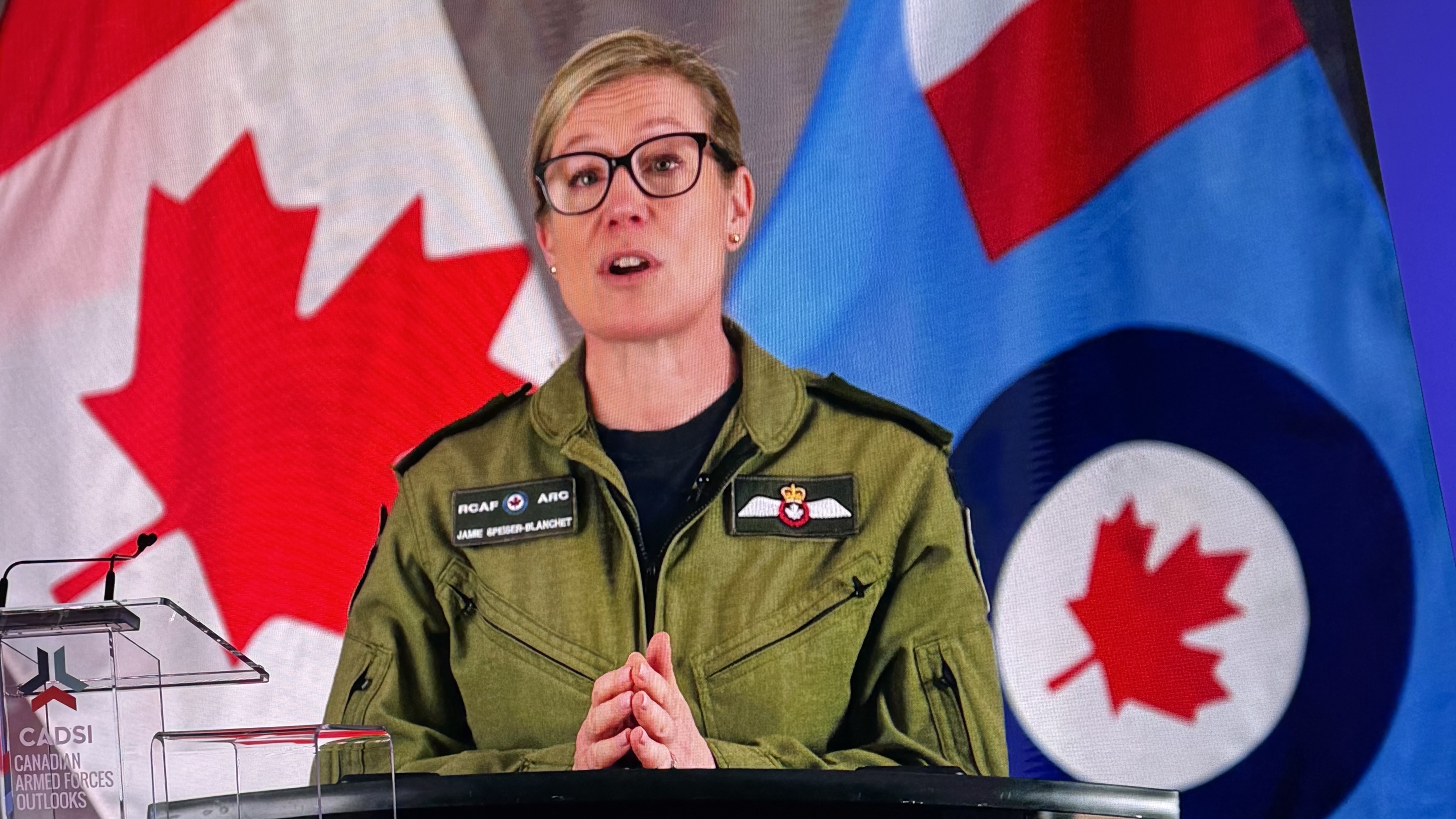
Lieutenant-General Jamie Speiser-Blanchet leads the RCAF through a pivotal modernization phase.
To see full published article, click here.
To see full published article, click here.
%4010x.png)
Media Contact
Katie Majkowicz
Digital Marketing & Communications Specialist
Samuel Associates Inc.
Digital Marketing & Communications Specialist
Samuel Associates Inc.
(613) 292-3936
km@samuel.associates
Related Article
No items found.
No items found.
No items found.

On the second day of the CAF Outlook Series, the Royal Canadian Air Force did not sound like an institution delivering a routine modernization update. It sounded like one making a strategic argument.
There were no triumphant declarations, no easy narratives of renewal. Instead, what emerged was a quiet but unmistakable shift in tone: away from procurement as process, and toward modernization as necessity. The RCAF is no longer simply replacing aging platforms. It is attempting to adapt to a world in which the assumptions that once underpinned Canadian security—distance, warning time, and continental insulation—are eroding.
This was not a presentation about equipment. It was a presentation about exposure.
Geography Is No Longer a Shield
For generations, Canada’s strategic comfort rested on its geography. Oceans provided depth. The Arctic provided distance. Conflict, when it came, would arrive with warning.
That logic no longer holds.
The threat environment outlined at Outlook was defined by proximity and speed. China’s rapid military expansion—across missiles, aircraft, space systems, and Arctic-adjacent activity—was framed not as a future concern, but as an ongoing reality. Russia, despite its war in Ukraine, retains the capacity to strike North America from range. Meanwhile, uncrewed systems, cyber operations, and AI-enabled influence campaigns have blurred the line between peacetime competition and active conflict.
The result is a strategic condition in which Canada is no longer buffered—it is increasingly exposed.
From Platforms to Systems
The most important shift in the RCAF’s thinking is conceptual.
For decades, air power was discussed in terms of fleets: fighters, transports, helicopters. That language still exists, but it is no longer sufficient. The RCAF is now oriented around what it calls a “fifth-generation ecosystem”—a force defined by integration rather than inventory.
Sensors, satellites, cyber capabilities, command-and-control networks, and effectors must function as a single system. The objective is not simply to possess advanced platforms, but to connect them in a way that enables faster, more informed decision-making.
The phrase repeated throughout the day—“detect first, decide first, act first”—is less a slogan than a design principle.
In this model, awareness without action is meaningless. And action without integration is ineffective.
The Compression Problem
If the strategic logic is clear, the practical challenge is daunting.
The RCAF outlined a modernization effort measured in the hundreds of billions of dollars, with more than 300 aircraft expected to enter service within a relatively short window. But the constraint is not only financial—it is institutional.
Canada is attempting to absorb decades of deferred investment in a matter of years. Pilots must be trained, infrastructure expanded, supply chains secured, and organizational cultures adapted—all while maintaining operational readiness. The system is being asked to transform while it continues to function.
There is a risk embedded in that compression. Not failure, necessarily, but friction—delays, bottlenecks, and the slow realization that capacity cannot be surged as easily as funding.
The RCAF appears aware of this. What was notable was not overconfidence, but restraint.
The North as a Test Case
Nowhere is the shift in thinking more visible than in the Arctic.
Canada’s northern geography has long been treated as a passive advantage. Today, it is increasingly understood as an active vulnerability. Adversaries can approach from over the horizon, operate in contested domains, and exploit gaps in surveillance and response.
The RCAF’s answer is presence—persistent, credible, and operationally meaningful. That means more than symbolic deployments. It requires infrastructure, logistics, refuelling capability, surveillance systems, and the ability to operate at scale in a harsh and changing environment.
Sovereignty, in this context, is not a legal concept. It is a capability.
Space Is No Longer Optional
If the Arctic represents Canada’s geographic frontier, space represents its strategic one.
The Outlook discussions made clear that space is no longer an enabling domain operating quietly in the background. It is central to everything—from navigation and communications to intelligence and targeting. And it is increasingly contested.
The RCAF’s focus on space-based ISR, domain awareness, and space control reflects a broader recognition: that modern defence is dependent on systems that are both indispensable and vulnerable.
To lose access to space is not to degrade capability. It is to lose coherence.
An Ecosystem, Not an Institution
Perhaps the most understated but important message of the day was this: the RCAF cannot do this alone.
The language used to describe industry was telling. It was not framed as a procurement relationship, but as a partnership within a broader defence ecosystem. This reflects a deeper reality. The future air force will depend on digital infrastructure, industrial capacity, and technological innovation as much as on aircraft and personnel.
Defence, in this sense, is no longer confined to the military. It is distributed across the state—and beyond it.
Canada has been slow to fully embrace this idea. It may no longer have the luxury of delay.
A Beginning, Not a Conclusion
There is a tendency in Canadian defence discussions to search for resolution—to ask whether a program is funded, whether a capability gap is closed, whether a policy has been finalized.
The second day of the CAF Outlook Series offered something different.
It did not present a finished solution. It presented a clearer understanding of the problem.
The Royal Canadian Air Force is not rebuilding the force it once had. It is attempting to construct the force it now needs—one that can operate in contested domains, respond at speed, and contribute meaningfully to continental defence in an era of uncertainty.
That effort is overdue. It is also incomplete.
The real question is no longer whether the RCAF understands the challenge. It does.
The question is whether Canada, as a country, is prepared to meet it.
To see full published article, click here.
%4010x.png)
To see full published article, click here.