Updated on:
April 7, 2026
CAF Outlook Series: Canada’s Defence Future Comes Into Focus
by

Samuel Associates
Posted on:
April 7, 2026
To see full published article, click here.
To see full published article, click here.
%4010x.png)
Media Contact
Katie Majkowicz
Digital Marketing & Communications Specialist
Samuel Associates Inc.
Digital Marketing & Communications Specialist
Samuel Associates Inc.
(613) 292-3936
km@samuel.associates
Related Article
No items found.
No items found.
No items found.

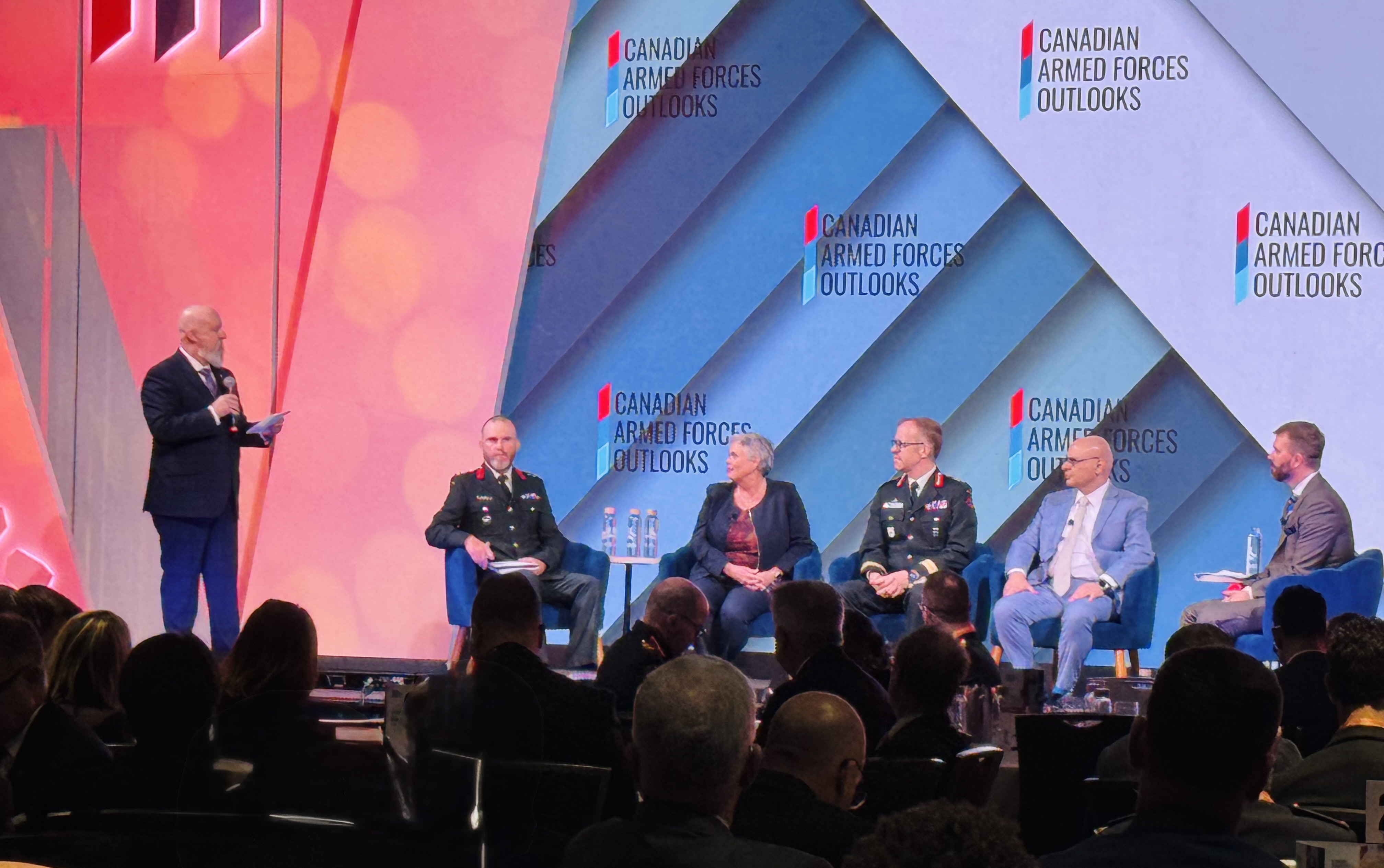
Ottawa has a way of making power look procedural. It can flatten urgency into briefing notes, schedule cards, and panels under conference room lighting. But every so often, an event cuts through the choreography and reveals something more consequential: that institutions are shifting, that priorities are hardening, and that the country is being forced, slowly, belatedly, but unmistakably, to take strategy seriously.
That is what the Canadian Armed Forces Outlook Series represents.
For those who work around defence, national security, procurement and government, the value of the series is not merely access, though access matters. It is a rare chance to hear the Canadian military speak plainly about what it believes is coming, what it lacks, and what it now needs from industry, government, and the broader national ecosystem. These are not abstract conversations. They are signals. And in a country that often confuses delay with prudence, signals matter.
This year, one of the clearest came from Lieutenant-General Mike Wright.
His message, and the broader tone of the Outlook discussions, was notable for its candour. The Canadian Army is not talking about routine modernization. It is talking about reconstitution, readiness, and national mobilization. In its own words, the institution must reform recruiting, expand training capacity, accelerate procurement, and work far more closely with industry to keep pace with a deteriorating global security environment.
This is not a rhetorical shift. It is a structural one.
For years, Canada could afford to treat defence as a secondary expression of policy, important, but rarely urgent. That era is ending. The return of major-power competition, the realities of Ukraine, growing pressure in the Arctic, and the fragility of global supply chains have all converged on a single conclusion: capability, not intent, defines credibility.
The Outlook Series is where that realization becomes visible.
At its core, the conversation is no longer about procurement cycles. It is about whether Canada can build, sustain, and deploy meaningful capability at speed. The Army alone is advancing roughly 50 major capital projects, representing more than $50 billion in investment, across areas such as long-range strike, air defence, Arctic mobility and integrated command systems.
But the more important shift is philosophical.
The model is changing: from slow, linear acquisition to iterative development; from closed processes to early industry engagement; from buying finished products to building ecosystems. Industry is no longer being asked to respond to requirements. It is being asked to help shape them.
That is a profound change for Canada.
And yet, it raises a harder question.
Because strategy is not defined by what is said in conference rooms, it is defined by what is executed afterward.
A Closing Reflection
Canada now faces a choice it has managed to defer for too long.
We can continue to operate within a system that is comfortable, cautious, and procedurally sound—but fundamentally misaligned with the speed and scale of the world we are entering.
Or we can accept what our own military leadership is now saying, clearly and without ambiguity:
- That readiness requires urgency.
- That capability requires risk.
- And that sovereignty requires capacity.
The Outlook Series makes one thing evident: those inside the system understand this.
The question is whether the rest of it is prepared to move.
Because if Canada does not act with purpose now, it will not fail dramatically.
It will fail quietly, by falling behind, by becoming dependent, and by forfeiting influence in the very alliances it relies upon.
And that is the kind of failure that is hardest to recover from.
To see full published article, click here.
%4010x.png)
To see full published article, click here.