Updated on:
September 16, 2026
Canada–EU Associate Membership: A New Strategic Partnership Takes Shape
by

Samuel Associates
Posted on:
September 16, 2026
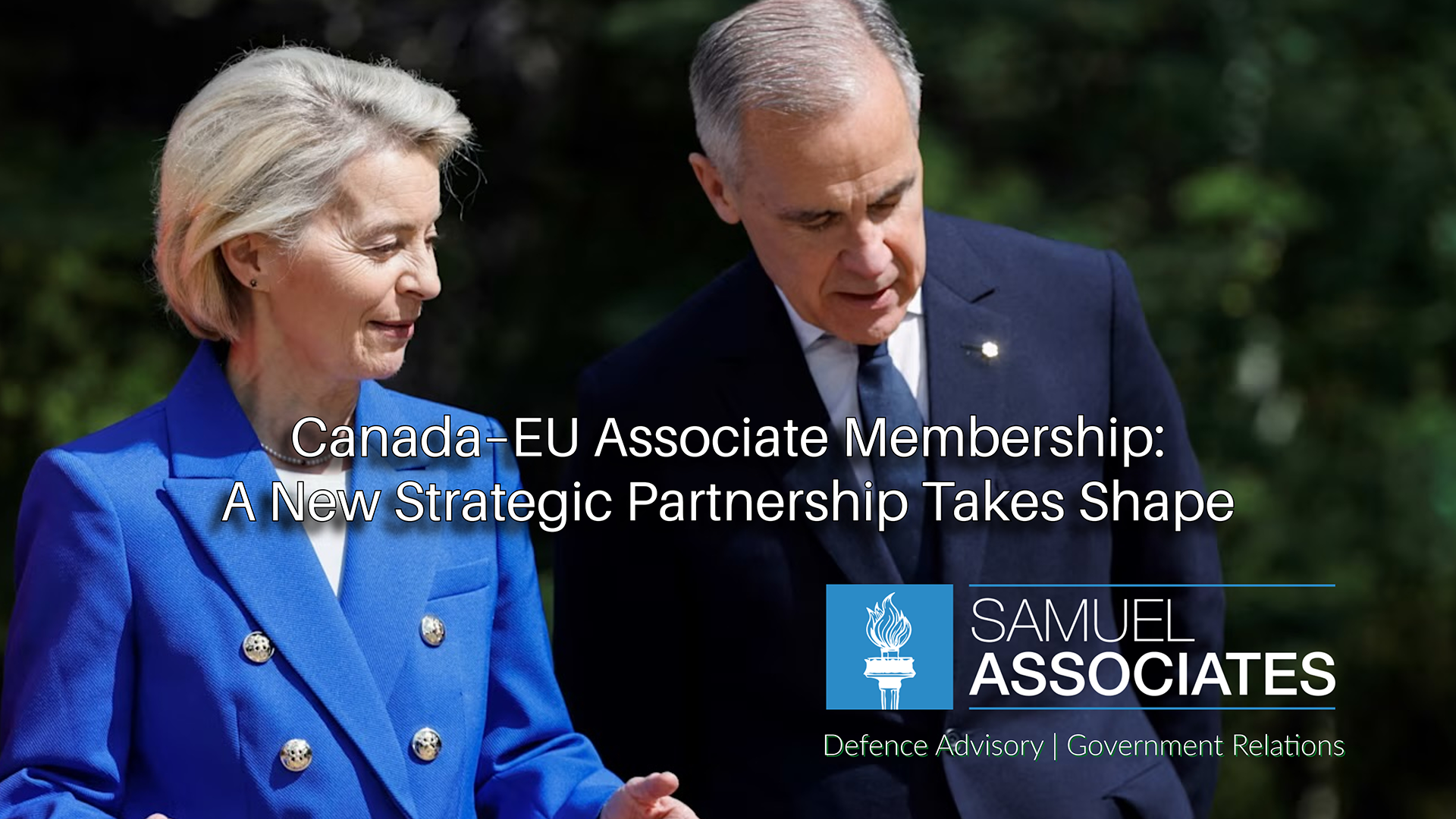
Prime Minister Mark Carney meets with European Commission President Ursula von der Leyen.
To see full published article, click here.
To see full published article, click here.
%4010x.png)
Media Contact
Katie Majkowicz
Digital Marketing & Communications Specialist
Samuel Associates Inc.
Digital Marketing & Communications Specialist
Samuel Associates Inc.
(613) 292-3936
km@samuel.associates
Related Article
No items found.
No items found.
No items found.

Samuel Associates anticipated the need for a new Canada–EU framework in 2025. Today, the prospect of Canada becoming the European Union’s first associate member could reshape defence, energy, critical minerals, nuclear cooperation and the Arctic.
In November 2025, Samuel Associates identified that the rapidly expanding Canada–European Union relationship would eventually require something new: a strategic framework capable of bringing Canada closer to the EU without becoming a full member.
In an interview with Canadian Defence Review for Arming Europe, Engaging Canada: The Readiness 2030 Opportunity, Goran Samuel Pesic, President and CEO of Samuel Associates, argued that Canada should look beyond traditional defence cooperation and pursue a more formal role within Europe’s emerging defence and security architecture.
Pesic proposed exploring an unprecedented form of Canadian observer participation, particularly with the European Defence Agency (EDA). The reasoning was straightforward: Europe was undertaking a historic expansion of its defence capabilities, its defence-industrial base was being transformed, and Canada possessed technologies, resources and industrial capabilities Europe increasingly needed.
Less than a year later, that strategic assessment has taken on new significance.
European Commission President Ursula von der Leyen has now invited Canada to explore becoming the European Union’s first associate member—potentially creating an entirely new category of Canada–EU relations.
The terminology differs from the proposal Samuel Associates advanced in 2025, and the details of any Canada–EU associate membership remain to be negotiated. But the strategic direction is remarkably similar.
Canada and the European Union are developing a relationship that is beginning to outgrow the traditional structures designed to manage it.
What Canada–EU Associate Membership Could Mean for Canadian Defence
The most immediate opportunity is defence.
Canada has already taken an important step toward greater European defence integration through participation in the EU’s Security Action for Europe (SAFE) initiative.
The next opportunity is larger.
Canada should seek to move beyond simply supplying defence products to Europe and become a more integrated partner within the European defence-industrial ecosystem.
That could mean Canadian companies participating in joint development, European defence programs, multinational supply chains, research and development, co-production and long-term sustainment.
Canada brings significant capabilities in aerospace, maritime systems, space, artificial intelligence, autonomous technologies, surveillance, secure communications, counter-drone systems and advanced manufacturing.
A deeper Canada–EU defence partnership could provide Canadian companies with greater access to European programs while strengthening Canadian manufacturing, intellectual property, skilled employment and sovereign defence-industrial capacity.
Energy and Critical Minerals
Defence, however, should only be one pillar of a broader Canada–EU strategic partnership.
Europe needs secure energy supplies and reliable access to critical minerals. Canada possesses both.
A deeper relationship could connect European investment and long-term demand with Canadian energy and resource development while creating opportunities to expand processing, refining and advanced manufacturing in Canada.
The objective should not simply be exporting Canadian raw materials.
Canada should use deeper European integration to build more of the critical-minerals value chain at home while helping Europe diversify strategic supply chains.
Canada–EU Nuclear Cooperation
Nuclear energy represents another natural area for deeper Canada–EU cooperation.
Canada has globally recognized capabilities in uranium, nuclear fuel, reactor technology, engineering and emerging small modular reactor (SMR) technologies.
As European countries place renewed emphasis on energy security and nuclear power, Canada has an opportunity to become an increasingly important long-term partner.
A broader Canada–EU framework could support nuclear research, technology partnerships, investment, fuel security and industrial cooperation lasting decades.
The Arctic and Canadian Sovereignty
The Arctic could become one of the most strategically important elements of a deeper Canada–EU relationship.
Canada faces significant requirements for Arctic surveillance, satellite communications, maritime domain awareness, infrastructure, transportation and energy.
European investment and technology could complement those priorities while supporting Canadian sovereignty and creating economic opportunities for Northern and Indigenous communities.
Any deeper European engagement in Canada's Arctic should be guided by a simple principle:
Cooperation should strengthen Canada's ability to understand, operate in and defend its North.
Technology, AI and Space
A future Canada–EU strategic partnership should also encompass the technologies that will shape economic and national security over the coming decades.
Canada and Europe have complementary strengths in artificial intelligence, quantum technologies, cybersecurity, space, advanced manufacturing and secure digital infrastructure.
Connecting European industrial scale and investment with Canadian research, technology and entrepreneurship could create new opportunities for companies on both sides of the Atlantic.
Building Stronger Canada–Europe Ties
The opportunity also extends beyond governments and industry.
Canada and Europe already share extensive commercial, cultural, educational and family connections.
A deeper Canada–EU relationship could strengthen trade, investment, research partnerships, student exchanges, professional mobility and entrepreneurship, creating stronger connections between Canadians and Europeans.
Canada also does not need to choose between its relationship with the United States and a deeper partnership with Europe.
Canada is simultaneously a North American nation, an Atlantic nation and an Arctic power. Stronger Canada–EU relations can broaden Canada's strategic options while complementing its relationships with the United States, NATO and other allies.
From Strategic Foresight to a Canada–EU Opportunity
The significance of the EU's proposal extends far beyond whether the eventual designation is called associate membership, observer status or something entirely new.
In November 2025, Samuel Associates argued that Canada and Europe should begin thinking beyond the institutional structures that existed at the time.
Today, that conversation has begun.
Canada now has an opportunity to help shape a new strategic framework encompassing defence and security, energy, critical minerals, nuclear technology, the Arctic, space, artificial intelligence, investment, trade and people-to-people ties.
The details will matter. So will ensuring that any agreement advances Canadian sovereignty, industrial capacity and economic interests.
But the direction is increasingly clear.
Canada and Europe are entering a new strategic era. The opportunity for Canada is not simply to participate in it—but to help shape it.
To see full published article, click here.
%4010x.png)
To see full published article, click here.