Updated on:
November 27, 2025
Rearming the Imagination: Canada’s Search for a Modern Defence Identity
by

Samuel Associates
Posted on:
November 27, 2025
To see full published article, click here.
To see full published article, click here.
%4010x.png)
Media Contact
Katie Majkowicz
Digital Marketing & Communications Specialist
Samuel Associates Inc.
Digital Marketing & Communications Specialist
Samuel Associates Inc.
(613) 292-3936
km@samuel.associates
Related Article
No items found.
No items found.
No items found.

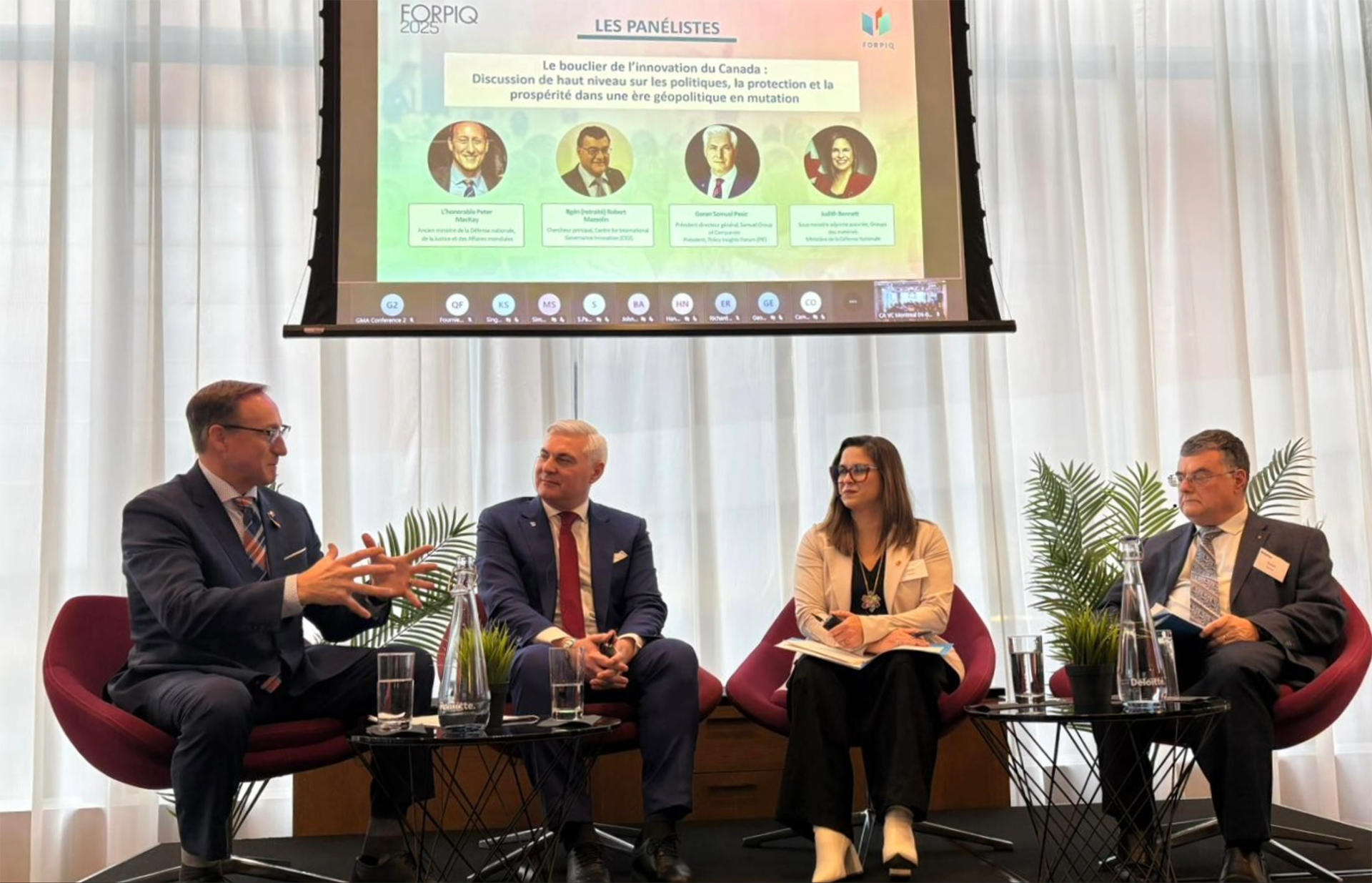
It began the way important Canadian discussions often do: quietly, earnestly, and with the sense that something larger was being gestured toward. In a Montréal auditorium, at an event organized by prominent Canadian IP lawyer David Durand, and beneath a banner declaring “The Shield of Canada’s Innovation,” four figures took their seats for what was billed as a high-level conversation on policy, protection, and prosperity in a shifting geopolitical era.
The panel brought together an unusually diverse mix of perspectives: The Honourable Peter MacKay, former defence, justice, and foreign affairs minister; Brigadier-General (Retired) Robert Mazzolin, now a principal researcher at the Centre for International Governance Innovation; Judith Bennett, Associate Assistant Deputy Minister responsible for materiel at National Defence; and Goran Samuel Pesic, President & CEO of the Samuel Group of Companies and President of the Policy Insights Forum.
Their discussion—stretching from Arctic surveillance to artificial intelligence—became something more than a policy briefing. It read as an invitation to reconsider how Canada understands its place in the world, and what it will take to defend that place in the decades ahead.
The System Canada Built for Another Time
Judith Bennett offered perhaps the most revealing insight of the afternoon. The problem with Canadian defence procurement, she explained, is not that the system is broken. It is that the system is working exactly as designed.
The trouble is that it was designed for a very different Canada.
For decades, the procurement apparatus assumed a slow, predictable pace of global affairs. It valued caution over urgency, consensus over speed, and process over adaptability. It was built for peacetime—deliberate, bureaucratic, and often intentionally risk-averse.
But the world has changed.
Defence spending has soared. Supply chains have fractured. Cyber and space domains evolve faster than committees can meet. Adversaries innovate without restraint. Allies rearm at a pace Canada has not matched. Mrs. Bennett’s message, understated but unmistakable, was this: the system Canada built for yesterday cannot deliver the capabilities it needs today.
How Decisions Actually Happen in Canada
If Mrs. Bennett described the machinery, it was Goran Samuel Pesic who mapped the logic behind it. Canadian defence procurement, he argued, rests on a chain of dependencies:
Politics shapes policy.
Policy defines programs.
Programs produce projects.
Projects result in procurement.
Break any link and the whole chain falters.
When political leadership hesitates, policy loses clarity. When policy is ambiguous, programs drift without direction. Projects then struggle to get off the ground, and procurement becomes mired in delay. It is not inefficiency, Mr. Pesic suggested—it is structural inertia.
He posed a question at once simple and profound: Is Canada competing with its allies, or collaborating with them?
In an alliance where many nations pursue the same technologies, duplication is unavoidable. But for a mid-sized industrial country like Canada, duplication is costly. It splits resources, drains talent, and forces the country to attempt too much with too little.
The Frontier Technologies Canada Cannot Ignore
Brigadier-General (Retired) Robert Mazzolin, whose career spans both military operations and advanced technology sectors, reminded the audience that the character of defence has changed more in the past decade than in the previous half-century.
Military power is now defined as much by:
- space-based intelligence
- cyber operations
- autonomous systems
- AI-enabled analytics
- digital command-and-control networks
as by ships or aircraft.
These systems evolve at commercial speed. They blur the boundary between civilian and military innovation. And they demand something Canada has not yet fully developed: an ecosystem capable of linking researchers, companies, universities, policymakers, and military operators in a common mission.
BGen (Ret.) Mazzolin noted that Canadian innovators often reach the threshold of breakthroughs—only to stall because no government entity is positioned to adopt, scale, or commercialize their work.
Innovation, he argued, does not die from lack of ideas.
It dies from lack of a pathway.
The Arctic: Canada’s Most Exposed Frontier
When Peter MacKay spoke of the Arctic, the tone sharpened. Climate change, he warned, has reshaped the geopolitical geometry of the North. New sea routes are opening. Russian and Chinese military interest has intensified. And Canada’s infrastructure—limited radar coverage, outdated surveillance systems, and vast undefended territory—has not kept pace.
With Finland and Sweden now in NATO, the circumpolar alliance is stronger. Yet Canada must choose whether it intends to lead within that framework or continue relying on geography and goodwill as substitutes for strategy.
For too long, the Arctic has occupied a comfortable space in Canadian identity but an ambiguous one in Canadian defence. Mr. MacKay suggested the two can no longer be separated.
The Pipeline Canada Needs but Has Not Built
Among the most compelling proposals came once again from Mr. Pesic: the creation of a centralized Office of Defence Innovation and Commercialization.
Such an office would serve as a national hub to:
- integrate research and procurement
- accelerate testing and adoption of Canadian technologies
- support commercialization and exports
- consolidate fragmented innovation efforts across government
- provide companies with a clear entry point into the defence ecosystem
Other countries—Israel, the United States, the United Kingdom—already operate with versions of this architecture. Canada, despite its talent and ambition, does not.
The result?
Promising companies wither. Ideas leave the country. Opportunities are lost not for lack of creativity, but for lack of connection.
The Case for Canadian Defence Champions
Mr. Pesic pushed the conversation further by proposing something many in Ottawa whisper about but few say aloud: Canada should aim to build one or two domestic defence primes.
Not monopolies, but national champions.
Companies with the scale and integration to:
- coordinate supply chains
- anchor sovereign capabilities
- safeguard Canadian intellectual property
- lead major platform development
- integrate small and medium-sized companies
- compete on the global stage
Countries of comparable size—Italy, South Korea, Norway, France, Germany, Sweden—have done this. Canada, he argued, has the capacity; what it lacks is a deliberate, long-term ambition to do so.
A Moment of Choice
The Montréal panel did not sound like a group predicting doom. If anything, its tone was one of measured resolve. Canada has the talent, the resources, and the alliances necessary to adapt to this new era. What it lacks is institutional alignment—and urgency.
Their collective message was clear:
- clarify political direction
- modernize defence procurement
- define and invest in sovereign capabilities
- assert leadership in the Arctic
- build a national innovation pipeline
- foster Canadian defence champions
- treat defence and economic security as inseparable
Canada has reached an inflection point. The world around it is moving quickly. The question now—posed implicitly by each panelist—is whether Canada will redesign its defence ecosystem for the world it wishes to live in, or remain bound to the systems it built for a world that no longer exists.
To see full published article, click here.
%4010x.png)
To see full published article, click here.