Updated on:
February 25, 2026
The Golden Age and the Northern Reality
by

Samuel Associates
Posted on:
February 25, 2026
To see full published article, click here.
To see full published article, click here.
%4010x.png)
Media Contact
Katie Majkowicz
Digital Marketing & Communications Specialist
Samuel Associates Inc.
Digital Marketing & Communications Specialist
Samuel Associates Inc.
(613) 292-3936
km@samuel.associates
Related Article
No items found.
No items found.
No items found.

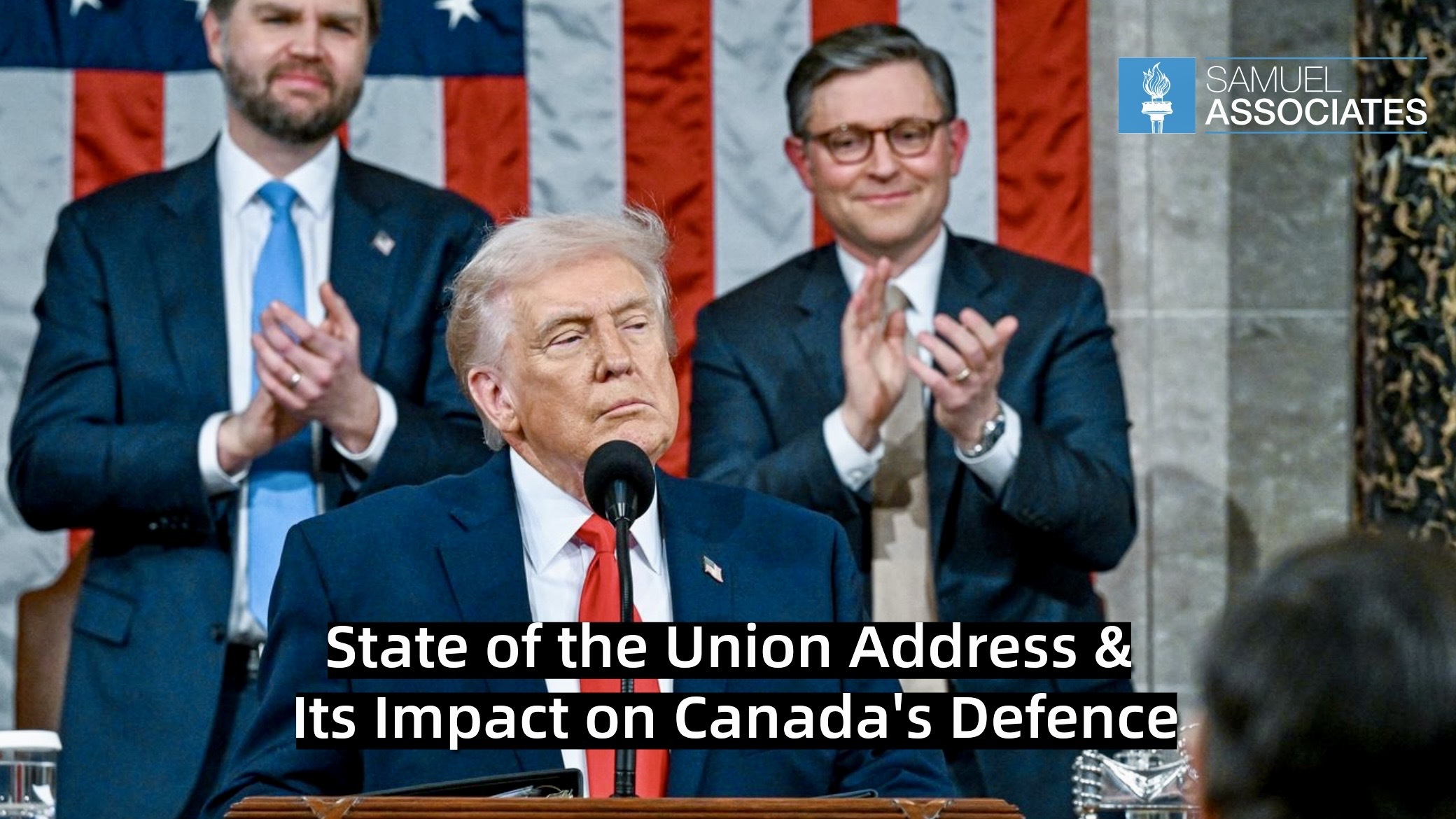
What President Trump’s State of the Union Means for Canada and Its Defence Industrial Base
When President Donald Trump declared that “the golden age of America is upon us,” he was not merely speaking to Congress. He was speaking to markets, to allies, and—implicitly—to competitors. For Canada, and particularly for Canada’s defence industrial ecosystem, the speech was less a rhetorical flourish than a strategic signal flare.
The address was long, combative, and triumphalist. It was also clear in its through-line: American sovereignty first, American industry first, American leverage first. Tariffs as power. NATO as cost-sharing mechanism. Energy as dominance. Security as precondition for prosperity. These themes are not new. But their consolidation into a second-term governing doctrine marks a structural shift for Canada’s strategic environment.
For Samuel Associates, observing from Ottawa with one foot in Washington, the speech confirms three realities: the American defence economy is accelerating; alliance expectations are hardening; and Canada’s window to reposition itself within North America’s security architecture is narrowing.
Tariffs, Trade and the Return of Industrial Statecraft
President Trump’s renewed defence of tariffs—even in the wake of a Supreme Court rebuke—signals that trade policy will remain a primary instrument of national power. He framed tariffs not as protectionism, but as strategic leverage—tools to reshape supply chains, rebalance alliances, and re-industrialize the American heartland.
For Canada, whose defence sector is deeply integrated into U.S. supply chains, this posture cuts both ways.
On one hand, the United States’ aggressive re-shoring and defence spending surge (including a proposed trillion-dollar defence budget) will expand demand for secure, trusted suppliers. Canada—NATO ally, NORAD partner, Five Eyes member—remains uniquely positioned to serve that demand.
On the other hand, “Buy American” pressures will intensify. Regulatory levers, export controls, and domestic-content thresholds could tighten. Even absent formal tariffs, procurement preferences may shift subtly but decisively toward U.S.-based primes and subsidiaries.The implication for Canadian defence firms is not retreat—but repositioning. Success will depend on deeper joint ventures, U.S. footprint expansion, and explicit alignment with American industrial priorities, including munitions production, space-based systems, Arctic surveillance, and AI-enabled capabilities.
NATO at 5 Percent: A New Baseline
Perhaps the most consequential line in the speech for Canada was the President’s assertion that NATO allies have agreed to spend 5 percent of GDP on defence . Whether this figure becomes binding policy or negotiating posture, it sets a rhetorical ceiling that reshapes expectations.
Canada currently remains well below NATO’s 2 percent benchmark. A 5 percent threshold is politically implausible in the near term—but strategically unavoidable as a reference point.The President’s framing was not merely fiscal; it was transactional. The United States will lead—but allies must pay. This reflects a broader American mood: support for alliances persists, but not without visible burden-sharing.
For Ottawa, this is not about appeasing Washington. It is about preserving influence within a continental defence framework that is rapidly modernizing. NORAD renewal, Arctic domain awareness, continental missile defence, and integrated space capabilities are no longer theoretical conversations—they are funded imperatives.
If Canada does not scale its defence industrial base accordingly, it risks marginalization within its own hemisphere.
Energy, AI and the Militarization of Infrastructure
President Trump’s remarks on energy and AI were framed as economic policy—but they carry defence implications. His insistence that AI companies build independent power infrastructure reflects a broader theme: strategic autonomy in critical systems.
For Canada, this intersects directly with defence industry competitiveness.
Energy abundance, rare earth access, Arctic mineral extraction, and secure digital infrastructure are becoming determinants of military-industrial relevance. The U.S. is linking energy policy to national security and industrial resilience. Canada must do the same.
The Canadian defence industry cannot be viewed in isolation from critical minerals strategy, grid modernization, or sovereign data infrastructure. The next generation of defence procurement will be inseparable from climate resilience, energy independence, and technological scale.
Immigration, Security and the Politics of Sovereignty
Much of the speech focused on border enforcement, internal security, and the projection of American strength. While these themes are domestically oriented, they influence the broader alliance climate.
The U.S. electorate is signalling fatigue with perceived vulnerability—economic, territorial, cultural. This sentiment translates into defence policy: hardened borders, expanded enforcement authorities, and a willingness to deploy military tools in unconventional ways.
For Canada, whose border remains the longest undefended in the world, alignment with U.S. security expectations will become increasingly scrutinized. Issues ranging from Arctic transit to export controls and technology screening will be assessed through a sovereignty lens in Washington.The political mood south of the border is not isolationist. It is selective, conditional, and unapologetically nationalist.
Implications for the Canadian Defence Industrial Base
From the vantage point of Samuel Associates, three strategic adjustments are essential:
1. Continental Integration Over Multilateral Abstraction
While Europe remains vital, Canada’s primary defence market and strategic anchor is the United States. Canadian firms must think continentally expanding U.S. subsidiaries, embedding within U.S. primes, and aligning with Pentagon modernization priorities.
2. Arctic as Strategic Differentiator
The speech’s emphasis on Western Hemisphere dominance and security underscores the Arctic’s rising salience. Canada’s comparative advantage lies in Arctic operations, cold-weather systems, and northern infrastructure. Ottawa should elevate Arctic defence industry clusters as pillars of continental resilience.
3. Policy-Industrial Synchronization
The United States is practicing industrial statecraft. Canada must respond in kind. Defence procurement reform, accelerated capital deployment, and structured public-private partnerships are no longer optional—they are prerequisites for relevance.
Beyond Partisanship: Structural Change
It would be a mistake to read the speech solely through partisan optics. Even critics acknowledged its strategic coherence. Beneath the theatrics lies a durable shift: American policy is consolidating around economic nationalism, alliance conditionality, and defence-industrial expansion.
Whether led by Republicans or Democrats, the trajectory toward greater U.S. defence spending, technological competition with China, and supply-chain securitization is unlikely to reverse.For Canada, this moment is clarifying.
The question is not whether we agree with every tone or tactic emerging from Washington. The question is whether we are structurally prepared to operate within a North American security architecture that is accelerating in scale, expectation, and ambition.
A Northern Choice
As America prepares to celebrate its 250th anniversary, President Trump cast the coming years as a renewal of national purpose. For Canada, the anniversary is less symbolic than strategic.We can remain reactive responding episodically to U.S. pressure on spending, trade, and procurement.
Or we can act proactively—positioning Canada as an indispensable partner in continental defence modernization, leveraging our Arctic geography, advanced manufacturing, aerospace heritage, and trusted ally status.From the perspective of Samuel Associates, the path forward is clear: deeper integration, sharper specialization and faster execution.
The golden age proclaimed in Washington will not automatically extend northward. It will reward those who align, adapt, and invest.Canada still has the capacity to do all three.
To see full published article, click here.
%4010x.png)
To see full published article, click here.