To see full published article, click here.
To see full published article, click here.
%4010x.png)
Media Contact
Katie Majkowicz
Digital Marketing & Communications Specialist
Samuel Associates Inc.
Digital Marketing & Communications Specialist
Samuel Associates Inc.
(613) 292-3936
km@samuel.associates
Related Article
No items found.
No items found.
No items found.

What Washington’s Silence—and Canada’s Defence Industrial Awakening—Reveal About the Future of the Canada–U.S. Relationship
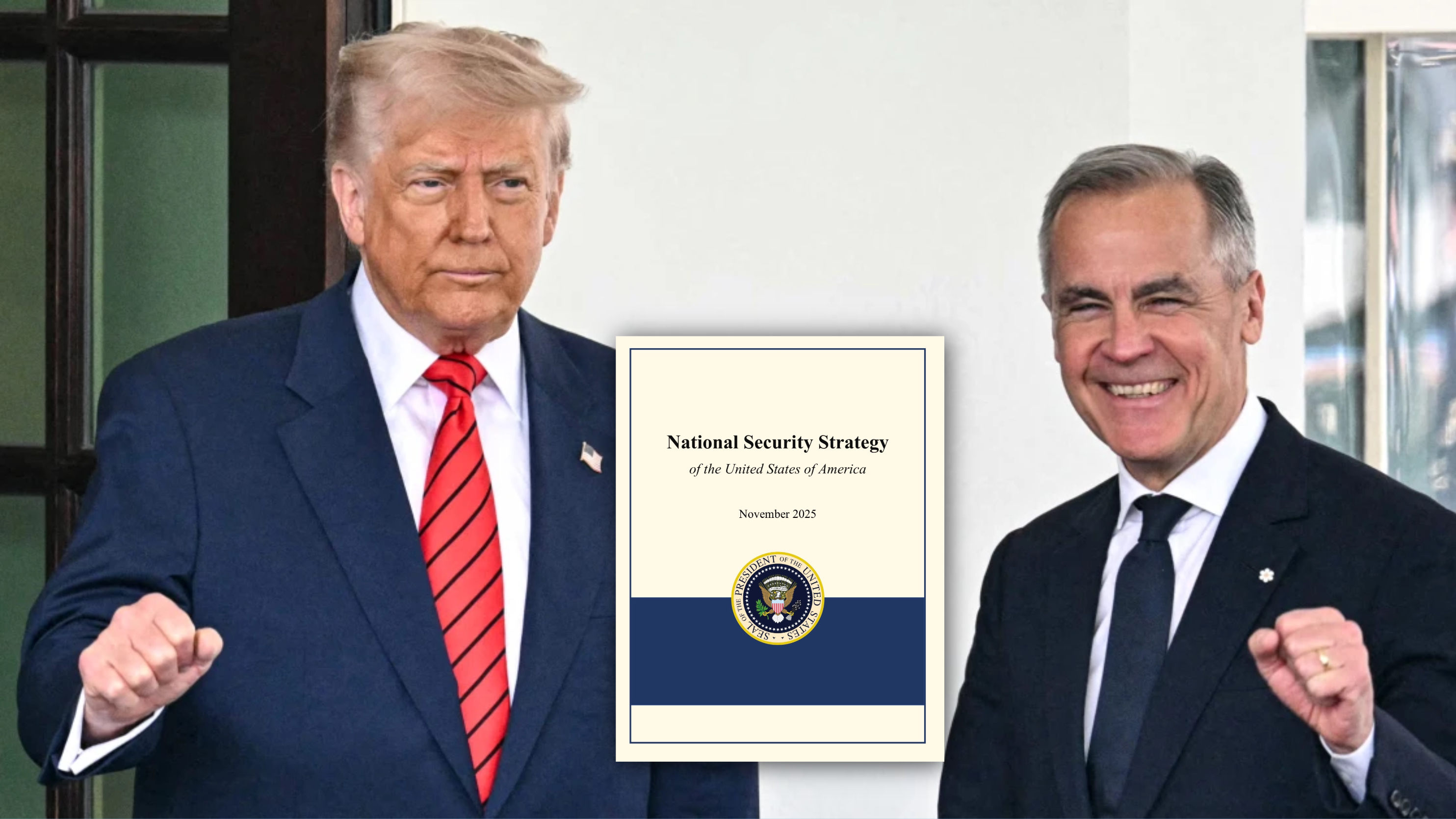
When the White House released its 2025 National Security Strategy, allied governments scoured the document for confirmation of their place in Washington’s worldview. Some nations found themselves elevated, such as Japan and South Korea as protectors of the First Island Chain in the South China Sea or India as a key contributor to Indo-Pacific security. Even small and geopolitically peripheral nations received mention for their roles in regional conflict resolution.
Canada, by contrast, appeared only once. And that solitary reference—tucked unceremoniously into a paragraph about rebalancing China’s industrial overcapacity—was hardly the fulsome acknowledgment Canadians often assume the country commands in Washington.
There was no mention of NORAD, perhaps the most enduring symbol of continental military integration.
No commentary on the Arctic, where Canada holds the majority of the northern coastline and shares a frontier with Russia.
Nothing about critical minerals, despite Canada’s vast reserves of the resources the United States now deems essential for the next century of industrial power.
No reference to the shared defence industrial base, a relationship older than NATO itself.
Not even a nod to Canada’s renewed pledge to reach 5 percent of GDP in defence spending by 2035—a goal that, on paper, should place Canada near the front of Washington’s strategic imagination.
To read the document, one might conclude that Canada had quietly stepped off the world stage.
But if Canada is disappearing from American strategy, it is not because the United States has changed. It is because the world has.
A New Strategic Era—and a Canada Missing From It
The 2025 U.S. strategy is not a polite enumeration of principles; it is a declaration of intent from a country that believes it has entered a dangerous era. In its telling, the post-Cold War “peace dividend” is over. The tools of national power—industrial capacity, energy abundance, critical minerals, military manufacturing, and continental alliances—must be rebuilt at speed.
In this worldview, the Western Hemisphere must once again be secured against foreign influence.
The Arctic is no longer a remote frontier, but a contested theater of geopolitical conflict.
Energy and minerals are geostrategic assets, not mere commodities.
China represents a systemic challenge requiring a return to deep allied alignment.
NATO countries must move, not toward the long-debated two percent defence spending threshold, but toward an ambitious five percent, levels not seen since the middle of the 20th century.
The strategy is muscular, impatient, and unembarrassed about asserting American primacy. But what is most striking for Canadians is what the document does not say. The omission of Canada is not accidental. It is structural. It reflects an American assessment—implicit but unmistakable—that Canada has drifted from the realm of strategic actor to that of strategic bystander.
This is not a condemnation. But it is a warning.
Canada will be central only if it chooses to be.
The End of the Peace Dividend in Ottawa
In Ottawa, policymakers have begun articulating a different kind of awakening. Appearing before the Standing Committee on Industry and Technology, I argued that Canada stands at its own strategic inflection point, one shaped not only by threats abroad but by the erosion of assumptions at home.
“The era of the peace dividend is over, and the strategic assumptions of the post-Cold War period no longer hold.”
This recognition is overdue. For three decades, Canada relied on a world where its geography, political stability, and alliance memberships were enough to guarantee relevance. But geography does not deter hypersonic missiles. Stability does not build icebreakers. Diplomacy does not produce satellites, radars, or ammunition.
Budget 2025 took an important step by introducing a Defence Industrial Strategy (DIS)—the first meaningful attempt in a generation to link Canada’s economic strengths to its strategic obligations. But a strategy, however promising, is only as meaningful as the vision behind it.
That vision must match the scale of the moment. It must treat defence not as procurement, but as national policy. And it must acknowledge that the Canada–U.S. relationship—the linchpin of our security and prosperity—is being quietly rewritten by forces far larger than sentiment.
The 5% Commitment: Canada’s Chance to Rejoin the Strategic Conversation
Canada’s pledge to reach 5 percent of GDP in defence spending by 2035 is one of the most ambitious commitments Ottawa has ever made. If implemented thoughtfully, it represents not simply a fiscal change but a generational transformation of Canada’s role in global security.
But credibility matters. The United States has grown weary of allies whose commitments lack detail. Washington wants to know what allies will buy, build, deploy, and deliver. Vague promises no longer shape strategy.
That is why a structured, three-pillar framework is essential—not only to modernize Canada’s forces, but to signal to the United States that Canada intends to once again pull its weight in the defence of the continent.
Pillar One: 2% for the Defence of the Continent
Under the first pillar, 2 percent of GDP would be devoted to continental defence co-development with the United States. This includes:
• Integrated air and missile defence for NORAD Modernization;
• Procurement of long-range strike capabilities, including consideration of B-21 Raider aircraft;
• Upgrades to command and control architecture to ensure full interoperability with American and Five Eyes partners;
• Next-generation sensor systems that extend Canada’s visibility of northern and maritime domains.
This pillar speaks directly to the U.S. strategy’s most urgent theme: hemispheric defence. In a decade transformed by Russian Arctic activity and Chinese technological encroachment, Canada’s ability to contribute meaningfully to North American security will determine its standing in Washington.
Today, the United States sees Canada as geographically essential but operationally limited. Pillar One is how Canada changes that perception—and how it re-enters the American strategic lexicon.
Pillar Two: 1% for the Arctic—Canada’s Forgotten Frontier
The second pillar assigns 1 percent of GDP to the Arctic, an area where Canada holds unmatched geographic advantage but limited infrastructure and ability to turn this advantage into capability. This investment would fund:
• Dual-use Arctic ports (including submarine-capable facilities);
• Satellite constellations and domain-awareness systems;
• Northern airfields and logistics networks;
• Modern icebreakers and patrol vessels;
• Resilient northern communities that can support sustained CAF presence.
Each of these investments would strengthen Canada’s sovereignty. But they would also do something far more important: make Canada indispensable to the United States in a region that is rapidly becoming a theatre of strategic competition.
In the American strategy, the Arctic is a problem to be solved. Canada’s opportunity is to ensure that solution includes Canada.
Pillar Three: 2% for industrial mobilization and allied support
The final pillar directs 2 percent of GDP toward expanding Canada’s defence manufacturing base and supporting allies in Europe and the Indo-Pacific. This includes:
• Scaled munitions production;
• Development of advanced dual-use technologies, such as quantum, AI, and cyber;
• Shipbuilding and autonomous systems;
• Mining and refining of critical minerals essential to allied supply chains.
Where Pillar One addresses security and Pillar Two the Arctic frontier, Pillar Three addresses capability. The U.S. strategy places enormous emphasis on reindustrialization, supply chain security, and critical minerals. These are areas where Canada can lead—not by proximity, but by capacity.
By matching American priorities with Canadian industrial strengths, Pillar Three turns defence spending into a national economic engine. It lays the foundation for Canadian firms to become suppliers not just to the U.S. Department of War, but to NATO, the EU, and Indo-Pacific partners confronting their own security challenges.
In short: it allows Canada to return to its status as a capable ally.
The Role of Metrics: Credibility Through Transparency
A ten-year roadmap is only meaningful if it is measurable. That is why explicit benchmarks—production targets, deployment milestones, infrastructure timelines—are essential to the plan. They serve three functions:
1. Accountability to Canadians, who must understand how a historic investment is being used.
2. Predictability for industry, which requires multi-year certainty to build factories, hire workers, and secure supply chains.
3. Signalling to Washington, which increasingly judges allied commitments by their concreteness, not their rhetoric.
If Canada says it will field B-21s, build Arctic ports, and produce munitions at scale, it must show when and how. That is how allies regain trust.
Why This Matters: The Politics of Visibility
In geopolitics, invisibility is rarely accidental. Canada’s near-total absence from the U.S. National Security Strategy is a mirror held up to our national posture. For years, Canadian foreign policy has relied on the belief that our reputation—as a calm, reasonable, well-liked democracy—was itself a form of influence.
But reputation cannot replace capability.
The United States is not turning away from Canada out of frustration or hostility. Rather, Washington is reorganizing its strategic worldview around nations that demonstrably shape outcomes: those who build, deploy, extract, manufacture, and defend.
Canada can be one of those nations again. But that future will not arrive by sentiment or by habit. It must be chosen—deliberately and at scale.
A Pathway to Re-Establishing Strategic Centrality
Reclaiming Canada’s place in American strategy requires bold steps—not incremental ones.
1. Present the 5% Framework to Washington as Canada’s Strategic Vision for meeting Canada’s NATO Commitment
The United States wants allies who know what they intend to contribute. A staged 2%/1%/2% plan shows:
• Capability,
• Predictability,
• And long-term reliability.
It transforms Canada’s defence spending from an abstract promise into a continent-shaping endeavour.
2. Propose a Canada–U.S. Continental Defence Compact
This would align Canadian investments with specific U.S. priorities:
• NORAD Modernization;
• Integrated missile defence;
• Shared B-21 infrastructure;
• Co-developed sensor and cyber capabilities.
3. Establish a Canada–U.S. Arctic Infrastructure Initiative
To ensure the Arctic is shaped by North American vision rather than foreign influence, Canada should propose joint:
• Arctic ports,
• Under-ice sensor networks,
• Satellite constellations,
• Northern operational hubs.
4. Build the Canada–U.S. Critical Minerals and Industrial Partnership
Formalizing cooperation in this domain would turn Canada into the backbone of North American supply chains—and position Canada, once again, at the centre of U.S. strategic planning.
5. Tell a New Story About Canadian Power
Canada must speak of itself not as a cautious middle power, but as a nation prepared to build, defend, and lead. That is the language Washington understands.
The Silence That Speaks
Canada’s disappearance from the 2025 U.S. National Security Strategy is not an insult. It is a reflection of a world in which power—not goodwill—shapes alliances.
But silence can be a beginning. By embracing a serious defence industrial strategy, by adopting a credible plan to reach 5 percent of GDP in defence spending, and by aligning its capabilities with the needs of the continent, Canada can once again be seen as a capable and essential ally in Washington’s strategic worldview.
The world has changed.
The United States has changed.
What remains is for Canada to decide whether it will change too.
Canada has the tools to reassert its relevance.
What it needs now is the ambition.
To see full published article, click here.
%4010x.png)
To see full published article, click here.